Plantar Fasciitis & Heel Pain in Moncton: Causes, Movement & Treatment Options

Heel pain is a common problem among people who spend long periods standing or walking, as well as runners and others who have recently increased their activity.
One of the most common causes of pain under the heel is plantar fasciitis, also referred to as plantar fasciopathy. It typically causes pain around the bottom or inner side of the heel and is often most noticeable during the first few steps after getting out of bed or after sitting for a period of time.
Although the painful area may seem small, persistent heel pain can affect walking, exercise, work, and everyday activities.
What Is the Plantar Fascia?
The plantar fascia is a strong band of connective tissue that runs along the bottom of the foot from the heel toward the toes.
It contributes to supporting the arch of the foot and helps the foot manage load during standing, walking, and running.
Plantar heel pain may develop when the plantar fascia and surrounding structures are repeatedly exposed to loads that exceed their current capacity.
This does not necessarily mean that there is one single cause. Activity level, recovery, footwear, ankle mobility, calf function, previous injuries, and individual movement patterns may all be relevant.
Common Symptoms of Plantar Fasciitis

The typical pattern is pain around the inner-bottom portion of the heel.
Pain is often worse with the first steps in the morning or after a period of rest. It may improve temporarily after moving around and then become more noticeable again after prolonged standing, walking, or running.
Tenderness near the heel and limitations in ankle movement may also be found during an assessment.
However, not every case of heel pain is plantar fasciitis.
Other conditions involving the heel, Achilles tendon, nerves, or bone can sometimes produce symptoms in a similar area. For this reason, the location and behaviour of the pain should be considered rather than assuming that every painful heel has the same cause.
Why Does Plantar Fasciitis Develop?
There is rarely one single explanation.
Symptoms may begin after a sudden increase in walking or running, starting a new exercise program, spending more time standing, changing footwear, or increasing activity on harder surfaces.
Calf flexibility, ankle mobility, foot and lower-limb strength, previous injuries, and the amount of load the foot is regularly exposed to may also be relevant.
For runners and active individuals, it can be useful to consider not only the painful heel but also how the ankle, knee, and hip contribute to overall movement.
This does not mean that every difference in posture or gait needs to be corrected. Movement findings are most useful when they are considered together with symptoms, activity demands, and the overall clinical assessment.
The Foot Is Part of a Larger Movement System
The foot does not function independently from the rest of the lower limb.
During walking and running, movement and load are shared between the foot, ankle, knee, hip, and pelvis.
For persistent heel pain, an assessment may therefore include ankle range of motion, calf flexibility, foot and lower-limb muscle function, and walking or running mechanics when clinically relevant.
This broader perspective is similar to the approach discussed in my articles on Hip Pain in Moncton, Knee Pain in Moncton.
Looking Beyond the Foot: Standing Posture and Gait
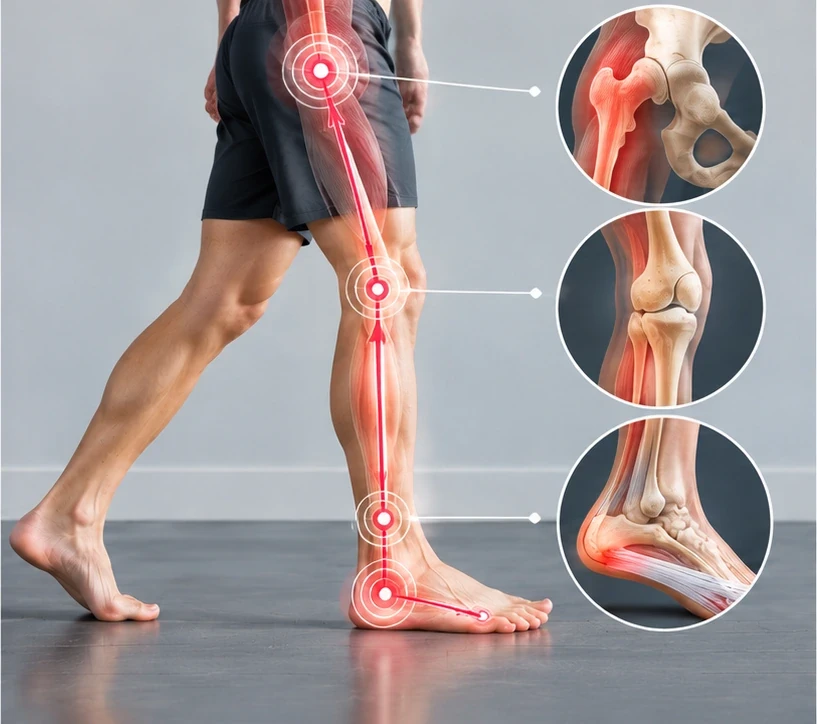
When relevant to a patient's symptoms, I may also observe standing posture and walking patterns as part of the clinical assessment.
In some patients, this may reveal noticeable asymmetry in weight distribution or a possible functional difference in leg length.
These findings do not automatically mean that something needs to be corrected. They are considered together with the person's symptoms, mobility, previous injuries, activity demands, and overall clinical presentation.
When footwear, foot mechanics, or a possible functional leg-length difference appears clinically relevant, I may recommend further assessment by an appropriate foot-care or orthotic professional.
In selected cases, foot orthoses or heel lifts may be considered as part of a broader management plan rather than as a stand-alone treatment.
The purpose is not to make every person's posture or gait look identical, but to determine whether a particular finding may be meaningfully related to the patient's symptoms and function.
What Treatments Have Evidence?
Current clinical practice guidelines support a combination of approaches rather than relying on one passive treatment alone.
Plantar fascia-specific stretching and calf stretching can help reduce pain and improve function.
Manual therapy directed toward relevant joint mobility or soft-tissue restrictions is also recommended in the 2023 clinical practice guideline for plantar heel pain.
Depending on the individual presentation, strengthening exercises, taping, footwear modification, orthoses, activity modification, or night splints may also be considered.
The most appropriate combination depends on the person's symptoms, activity level, clinical findings, and response to care.
What About Acupuncture?
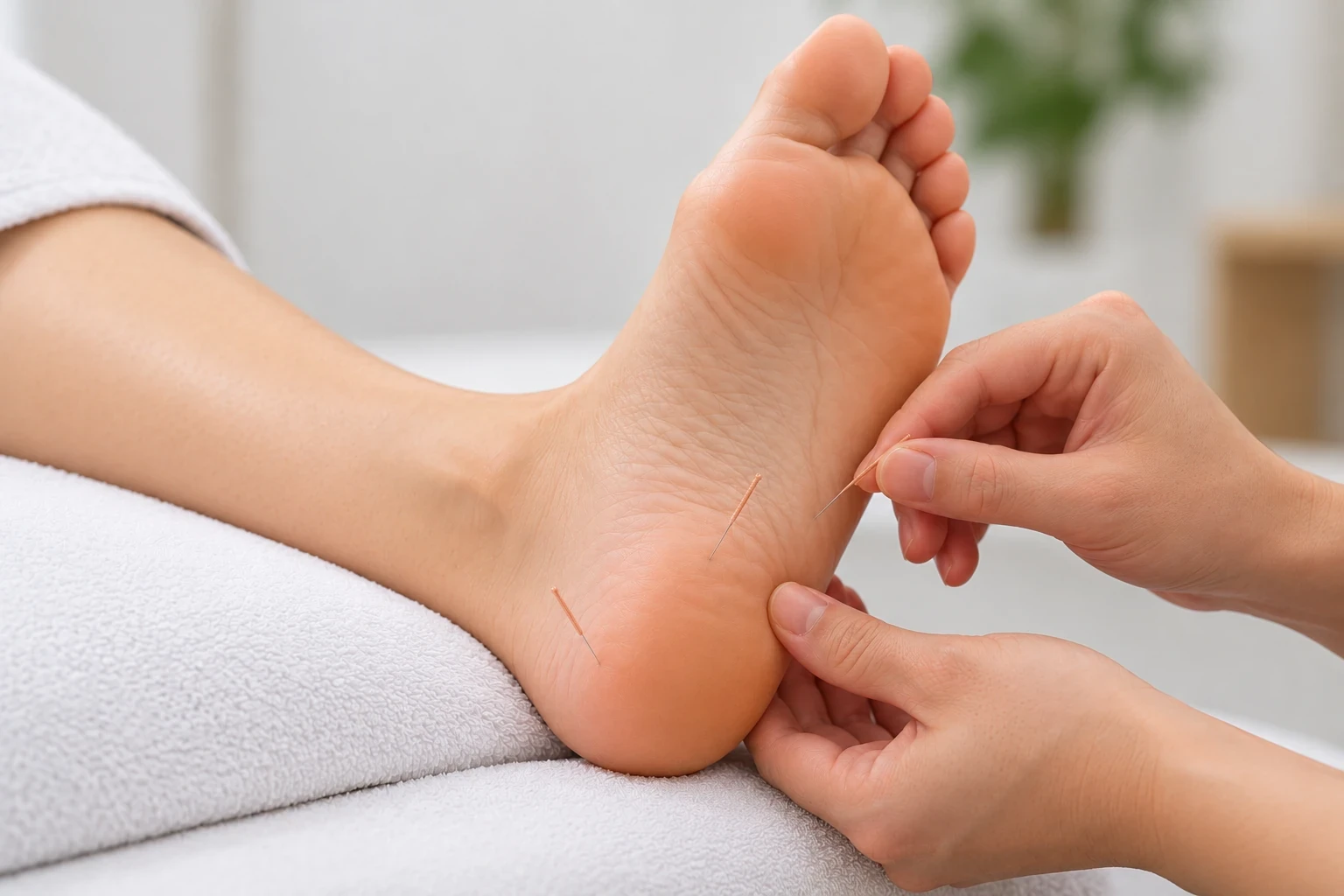
Recent clinical research suggests that acupuncture may help with pain and function in some people with persistent plantar heel pain.
A 2026 randomized controlled trial involving 120 people with chronic, difficult-to-treat plantar fasciitis compared two acupuncture protocols with a waitlist control. At four weeks, a greater proportion of participants receiving acupuncture achieved a meaningful reduction in pain compared with the waitlist group, with benefits continuing during follow-up.
Another 2026 multisite randomized clinical trial compared a home exercise program alone with electroacupuncture combined with the same exercise program. The electroacupuncture-plus-exercise group showed greater improvements over time in both pain and foot function.
These findings are encouraging and add to the growing research on acupuncture for plantar heel pain.
However, treatment should still be individualized and considered alongside exercise, appropriate load management, footwear, and other relevant strategies rather than relying on a single treatment alone.
What Does Korean Medicine Research Show?
Plantar fasciitis has also been studied within Korean medicine research.
A 2025 review published in the Journal of Korean Medicine Rehabilitation examined 29 clinical studies on Korean medicine treatments for plantar fasciitis published between 2015 and 2024.
The studies included a range of interventions such as acupuncture, electroacupuncture, manual therapy, moxibustion, cupping, and other treatment approaches.
Most of the included studies reported positive outcomes, but the treatment methods and outcome measures varied considerably.
The authors concluded that the findings were promising while also emphasizing the need for larger and better-standardized clinical trials.
This reflects an important point in clinical practice: evidence for plantar heel pain continues to develop, and treatment should be based on the individual presentation rather than on one technique alone.
Where Can Chuna Manual Therapy Fit?
When clinically appropriate, Chuna manual therapy may be used alongside acupuncture to address relevant mobility or soft-tissue findings in the foot, ankle, or lower limb.
The 2023 clinical practice guideline for plantar heel pain supports manual therapy directed toward relevant joints and soft tissues to help decrease pain and improve function.
The research supporting this recommendation relates to manual therapy as a broader treatment category rather than specifically to Chuna.
For this reason, Chuna manual therapy may be considered when the clinical assessment identifies relevant mobility or movement findings, rather than being applied routinely to every person with heel pain.
When Should Heel Pain Be Assessed?
Heel pain should be assessed when it persists, worsens, significantly limits normal activity, or does not follow the typical pattern of plantar fasciitis.
Symptoms such as numbness or tingling, significant swelling, sudden pain after an injury, difficulty bearing weight, or pain that continues to worsen may suggest that another cause should be considered.
People with medical conditions that affect circulation, sensation, or foot health should also seek appropriate medical assessment when new or unexplained foot pain develops.
An Individualized Approach to Heel Pain
Two people with plantar heel pain may have very different contributing factors.
One person may have recently increased running volume, while another may spend most of the day standing at work. Another may have limited ankle mobility, reduced calf capacity, an asymmetrical loading pattern, or symptoms influenced by previous lower-limb injuries.
For this reason, treatment should focus on the individual rather than on the diagnosis alone.
My approach considers the location and behaviour of the symptoms together with relevant mobility, standing posture, gait, activity, and clinical findings.
Acupuncture, electroacupuncture, or Chuna manual therapy may be considered when appropriate, while exercise, load management, footwear, orthotic assessment, or referral to another healthcare professional may also form important parts of care.
Heel Pain Care in Moncton
If heel pain is affecting your walking, exercise, work, or everyday activities, an individualized assessment can help clarify the pattern of your symptoms and determine which treatment options may be appropriate.
Learn more about my acupuncture and manual therapy services.
Jung Dae Kwon, R.Ac.
Registered Acupuncturist in New Brunswick
Clinical focus on musculoskeletal pain, movement, mobility, posture, and gait-related concerns.
Book an acupuncture appointment in Moncton.
References
Koc TA Jr, Bise CG, Neville C, et al. Heel Pain – Plantar Fasciitis: Revision 2023. Clinical Practice Guidelines Linked to the International Classification of Functioning, Disability and Health. Journal of Orthopaedic & Sports Physical Therapy. 2023;53(12)–CPG39. doi:10.2519/jospt.2023.0303.
Wang W, Kang J, Wang X, et al. Efficacy of Acupuncture for Chronic Recalcitrant Plantar Fasciitis: A Randomized Trial. Complementary Therapies in Medicine. 2026;97:103329. doi:10.1016/j.ctim.2026.103329.
Moss D, Rasmussen B, Williams W, Crawford P. Electroacupuncture for Plantar Fasciopathy: A Multisite Randomized Clinical Trial. Medical Acupuncture. 2026;38(1):43–53. doi:10.1089/acu.2024.0107.
Lee SH, Chung WS. An Analysis of Research Trends of Korean Medicine Treatments for Plantar Fasciitis. Journal of Korean Medicine Rehabilitation. 2025;35(2):65–76.
This article is provided for general educational purposes and is not a substitute for medical diagnosis or treatment. Individual results and treatment needs may vary.
FAQ
Answers to your questions
Common questions about acupuncture care, appointments, treatment, insurance, and what to expect during your visit.
How do I book an appointment?
Do you accept walk-in patients?
Are you licensed and experienced?
Can I reschedule or cancel my appointment?
What types of health insurance do you accept?
Start With an Individualized Assessment
Book your appointment today and start feeling better.

Start With an Individualized Assessment
Book your appointment today and start feeling better.
Start With an Individualized Assessment
Book your appointment today and start feeling better.