
Knee pain can affect walking, stairs, exercise, work, sports, and many everyday activities.
For some people, symptoms begin after a specific injury such as a twist, fall, awkward landing, or sports-related incident. For others, knee discomfort develops gradually over time without one obvious event.
Because the knee contains cartilage, menisci, ligaments, tendons, muscles, bursae, and other structures, there are many possible reasons for knee pain. Symptoms may also be influenced by how the hip, ankle, and foot work together during movement.
Understanding the pattern of symptoms and how the knee functions during everyday activities is an important first step in determining an appropriate approach to care.
What Is Knee Pain?

The knee is a large weight-bearing joint connecting the thigh bone, or femur, with the shin bone, or tibia. The kneecap, or patella, sits at the front of the joint and helps the quadriceps muscles control knee movement.
Several structures contribute to knee stability and movement, including:
Articular cartilage
Medial and lateral menisci
Anterior cruciate ligament (ACL)
Posterior cruciate ligament (PCL)
Medial collateral ligament (MCL)
Lateral collateral ligament (LCL)
Tendons and muscles
Joint capsule and bursae
Because these structures have different functions, knee pain is not one single condition.
Two people may both describe “knee pain” while having very different underlying problems and different treatment needs.
Common Symptoms of Knee Problems
Knee symptoms can vary depending on the condition and how it developed.
Common symptoms may include:
Pain at the front, inside, outside, or back of the knee
Pain when walking or standing
Discomfort when going up or down stairs
Pain with squatting or kneeling
Stiffness after sitting or resting
Swelling around the knee
Clicking, catching, or grinding sensations
Reduced knee movement
Weakness or difficulty trusting the knee
A sensation that the knee may give way
Pain during or after exercise
The location of pain alone does not always identify the exact structure involved. The overall history, movement pattern, activity level, and clinical findings should be considered together.
Common Causes of Knee Pain
Knee Osteoarthritis

Knee osteoarthritis is a progressive joint condition that can affect cartilage and other tissues within the knee.
It is sometimes described simply as “wear and tear,” but osteoarthritis is more complex than cartilage wearing away alone. Changes may occur throughout the joint and can influence movement, strength, comfort, and function.
Common symptoms may include:
Gradually increasing knee pain
Stiffness after rest
Swelling
Reduced range of motion
Discomfort with prolonged walking
Difficulty with stairs or getting up from a chair
Grinding or creaking sensations
Imaging findings and symptoms do not always match exactly. Some people may have significant changes on an X-ray with relatively mild symptoms, while others may experience considerable discomfort with less dramatic imaging findings.
For this reason, symptoms, function, activity level, and clinical findings should be considered together rather than relying on imaging alone.
Meniscus Injuries
The medial and lateral menisci are crescent-shaped structures located between the femur and tibia.
They help distribute load through the knee and contribute to joint stability and smooth movement.
Meniscus injuries can occur during twisting or pivoting movements, particularly during sports. Degenerative meniscus changes can also develop gradually over time.
Symptoms may include:
Pain along the joint line
Swelling
Pain with twisting or squatting
Catching sensations
Difficulty fully bending or straightening the knee
Occasional locking
Not every meniscus injury requires surgery. Management depends on the type of injury, symptoms, activity level, associated injuries, and whether the knee is mechanically restricted.
Knee Ligament Injuries — ACL, PCL, MCL and LCL
Four major ligaments help stabilize the knee.
The ACL and PCL help control movement between the femur and tibia, while the MCL and LCL contribute to side-to-side stability.
Ligament injuries may occur with:
Sudden changes of direction
Pivoting
Awkward landings
Sports collisions
Falls
Direct trauma to the knee
Depending on the severity of the injury, symptoms may include pain, rapid swelling, reduced movement, difficulty bearing weight, or a feeling that the knee is unstable or may give way.
An ACL or PCL tear is a structural injury. Acupuncture cannot reconnect or reconstruct a torn ligament.
Significant ligament injuries require appropriate medical assessment and rehabilitation, and some cases may require orthopedic evaluation or surgery.
Acupuncture may sometimes be considered as supportive care during recovery to help manage pain, surrounding muscle tension, or movement-related discomfort, but it does not replace structural diagnosis or rehabilitation.
Patellofemoral Pain
Patellofemoral pain generally refers to discomfort around or behind the kneecap.
Symptoms may become more noticeable with:
Stairs
Squatting
Running
Kneeling
Repeated bending
Sitting with the knee bent for a prolonged period
Patellofemoral pain can be influenced by several factors rather than one single structure.
Training load, muscle strength, movement control, previous injuries, hip mechanics, ankle mobility, and changes in activity may all be relevant.
For this reason, assessment should look beyond the kneecap alone and consider how the entire lower limb functions during movement.
Tendon, Bursa and Other Soft-Tissue Irritation
Tendons connect muscles to bone, while bursae are small fluid-filled structures that help reduce friction around joints.
Repeated loading, sports, kneeling, or sudden increases in activity may irritate these tissues.
Common examples include patellar tendon irritation and bursitis.
Because symptoms can overlap with other knee conditions, persistent swelling or localized pain should not automatically be assumed to be tendonitis or bursitis without appropriate assessment.
The Knee Does Not Work in Isolation
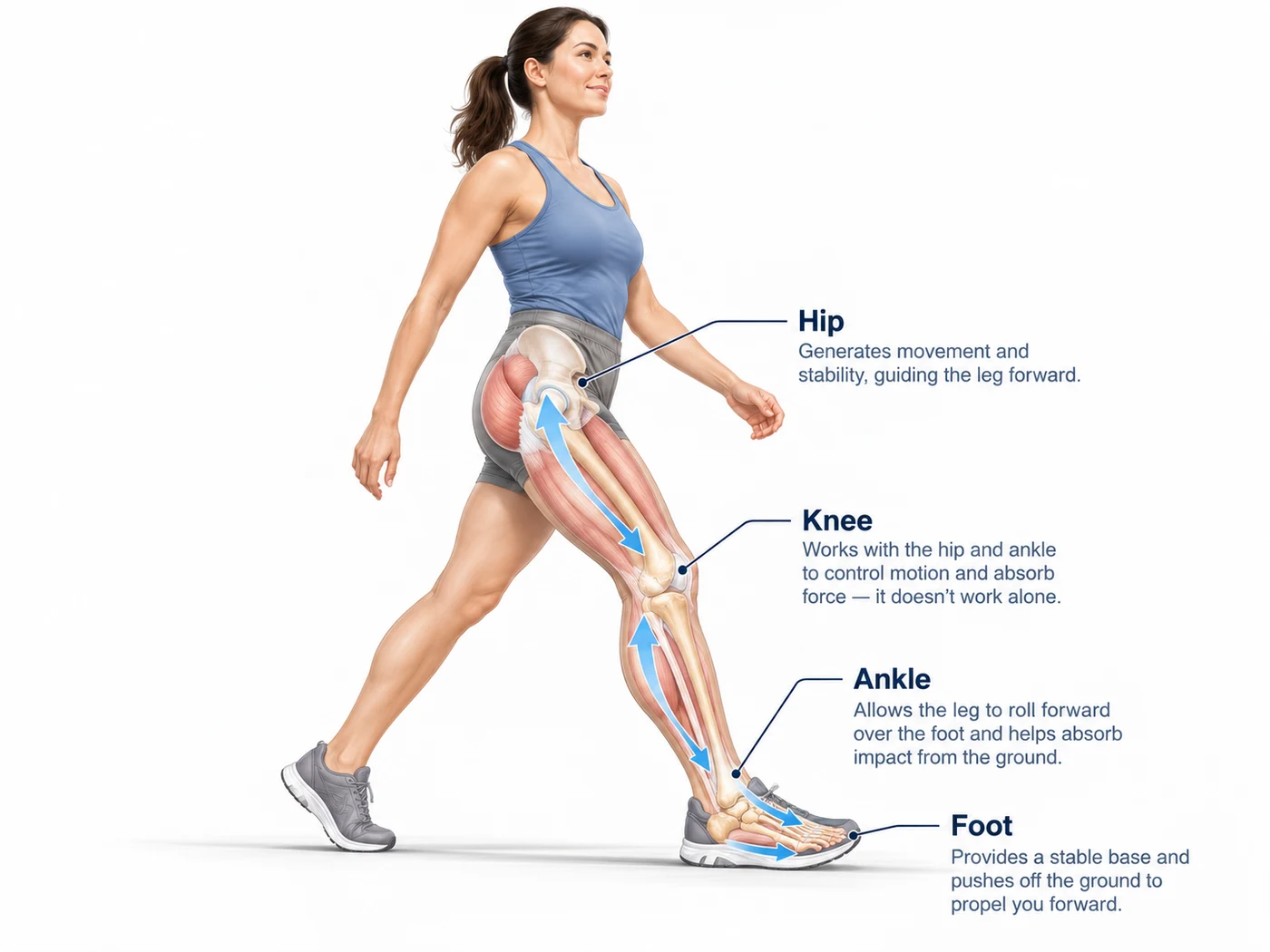
The knee works as part of a larger movement system.
The hip, knee, ankle, and foot continually interact when we stand, walk, climb stairs, squat, run, or change direction.
Factors that may influence how forces are distributed through the knee include:
Hip strength and control
Ankle mobility
Foot mechanics
Previous injuries
Muscle strength
Balance and coordination
Walking pattern
Changes in training or activity
This does not mean that every knee problem is caused by posture, gait, flat feet, or hip weakness.
Rather, these factors may be relevant in some individuals and should be considered together with the knee itself.
During an assessment, I may therefore look not only at where the knee hurts, but also at how a person stands, walks, bends the knee, transfers weight, and uses the hip and ankle during movement.
Do I Need an X-Ray or MRI for Knee Pain?
Imaging is not necessary for every person with knee pain.
The history of the problem, symptoms, swelling, range of motion, stability, strength, and physical assessment can provide important information before imaging is considered.
However, imaging may be appropriate when there is concern about:
Significant trauma
Possible fracture
Major ligament injury
Meniscus injury
Persistent or unexplained swelling
Significant loss of function
Mechanical locking
Symptoms that do not improve as expected
MRI may be particularly useful when a significant ligament, meniscus, cartilage, or other soft-tissue injury is suspected.
If you already have an X-ray, MRI, ultrasound, or radiology report, bringing it to your appointment may provide additional clinical context.
Imaging findings should be considered together with symptoms and function rather than interpreted in isolation.
When Should You Seek Medical Attention?
Some knee problems require prompt medical assessment.
Seek appropriate medical care if you experience:
Severe pain after significant trauma
Inability to bear weight
Obvious deformity
Marked or rapidly increasing swelling
A knee that becomes mechanically locked
Repeated significant instability
A hot and markedly swollen joint
Fever or feeling generally unwell
Suspected fracture or major ligament injury
A suspected significant ACL, PCL, meniscus, fracture, or other structural injury should be appropriately assessed rather than managed with acupuncture alone.
Treatment and Management Options for Knee Pain
Treatment depends on the cause of the symptoms, severity, duration, activity level, general health, and individual goals.
Depending on the condition, management may include:
Temporary modification of aggravating activities
Progressive exercise
Strengthening
Mobility work
Rehabilitation
Gradual return to normal activities
Medical treatment when appropriate
Weight management when clinically appropriate
Acupuncture or other supportive therapies
For knee osteoarthritis in particular, regular physical activity and therapeutic exercise are important components of long-term management.
Significant structural injuries may require assessment by a physician, physiotherapist, sports medicine provider, or orthopedic specialist.
Can Acupuncture Help With Knee Osteoarthritis?
Evidence on acupuncture for knee osteoarthritis continues to evolve.
The American Academy of Orthopaedic Surgeons states that acupuncture may improve pain and function in people with knee osteoarthritis.
Korean Medicine clinical practice guidelines also recommend considering acupuncture and electroacupuncture as options for managing pain and improving function.
Recommendations vary among clinical guidelines, and acupuncture should therefore be considered as one possible part of an individualized management plan rather than as a treatment that reverses cartilage degeneration.
Depending on the individual, acupuncture may be used alongside exercise, rehabilitation, activity modification, and appropriate medical care to help manage symptoms and support comfortable movement and daily function.
What About Acupuncture for ACL, PCL, Meniscus or Cartilage Injuries?
It is important to distinguish symptom management from structural repair.
Acupuncture does not reconnect a torn ACL or PCL, restore a torn meniscus, or regenerate damaged articular cartilage.
These injuries may require medical assessment, rehabilitation, imaging, or orthopedic care depending on their severity.
Where appropriate, acupuncture may be used as a supportive approach during recovery to help manage:
Pain
Muscle tension around the knee
Movement-related discomfort
Symptoms that may accompany rehabilitation
The goal is to support the overall recovery process, not to replace appropriate diagnosis, rehabilitation, or surgical care when those are indicated.
How Acupuncture May Fit Into Knee Pain Management

For some people with knee pain, acupuncture may be considered as one component of a broader conservative care plan.
In my practice, treatment is individualized according to the location and pattern of symptoms, how the problem began, knee movement, activity history, previous injuries, muscle tension, walking and movement patterns, and relevant medical findings.
Depending on the assessment, treatment may include acupuncture and, where appropriate, electroacupuncture or manual therapy within my scope of practice.
The goal is to help manage symptoms and support comfortable movement and everyday function.
Acupuncture does not replace appropriate medical assessment, imaging when indicated, orthopedic care, or rehabilitation for significant structural knee injuries.
What to Expect at Your First Appointment
Your first appointment begins with a discussion of your symptoms and medical history.
I may ask:
When the knee pain began
Whether there was an injury
Where the discomfort is located
Which activities make it better or worse
Whether swelling is present
Whether the knee feels unstable
Whether there is catching or locking
How the symptoms affect walking, stairs, work, exercise, or sport
The assessment may also include knee movement and other relevant clinical findings.
Depending on the individual situation, I may observe how the hip, knee, ankle, and foot work together during standing or walking.
If you have previous X-rays, MRI results, ultrasound reports, or other relevant medical records, you are welcome to bring them to the appointment.
If acupuncture is appropriate, an individualized treatment approach can then be discussed based on the assessment and your response to care.
Knee Pain and Acupuncture Care in Moncton
If knee pain is making walking, stairs, exercise, work, or everyday activities uncomfortable, an individualized assessment can help clarify the pattern of symptoms and determine whether acupuncture may be an appropriate part of your overall care.
Learn more about my acupuncture and manual therapy services.
Acupuncture appointments for knee and musculoskeletal pain are available in Moncton, New Brunswick.
Book an acupuncture appointment in Moncton.
Written by Jung Dae Kwon, R.Ac.
Registered Acupuncturist in New Brunswick
Doctor of Korean Medicine — Licensed in the Republic of Korea
References & Clinical Resources
Korean Medicine Clinical Practice Guideline — Knee Osteoarthritis → National Clearinghouse for Korean Medicine – Knee Osteoarthritis
AAOS — Management of Osteoarthritis of the Knee (Non-Arthroplasty), 3rd Edition → AAOS Knee OA GuidelineAAOS — Management of Anterior Cruciate Ligament Injuries → AAOS ACL Clinical Practice Guideline
This article is provided for general educational purposes and is not a substitute for medical diagnosis or treatment. Individual conditions and treatment needs may vary.
FAQ
Answers to your questions
Common questions about acupuncture care, appointments, treatment, insurance, and what to expect during your visit.
How do I book an appointment?
Do you accept walk-in patients?
Are you licensed and experienced?
Can I reschedule or cancel my appointment?
What types of health insurance do you accept?
Start With an Individualized Assessment
Book your appointment today and start feeling better.

Start With an Individualized Assessment
Book your appointment today and start feeling better.
Start With an Individualized Assessment
Book your appointment today and start feeling better.