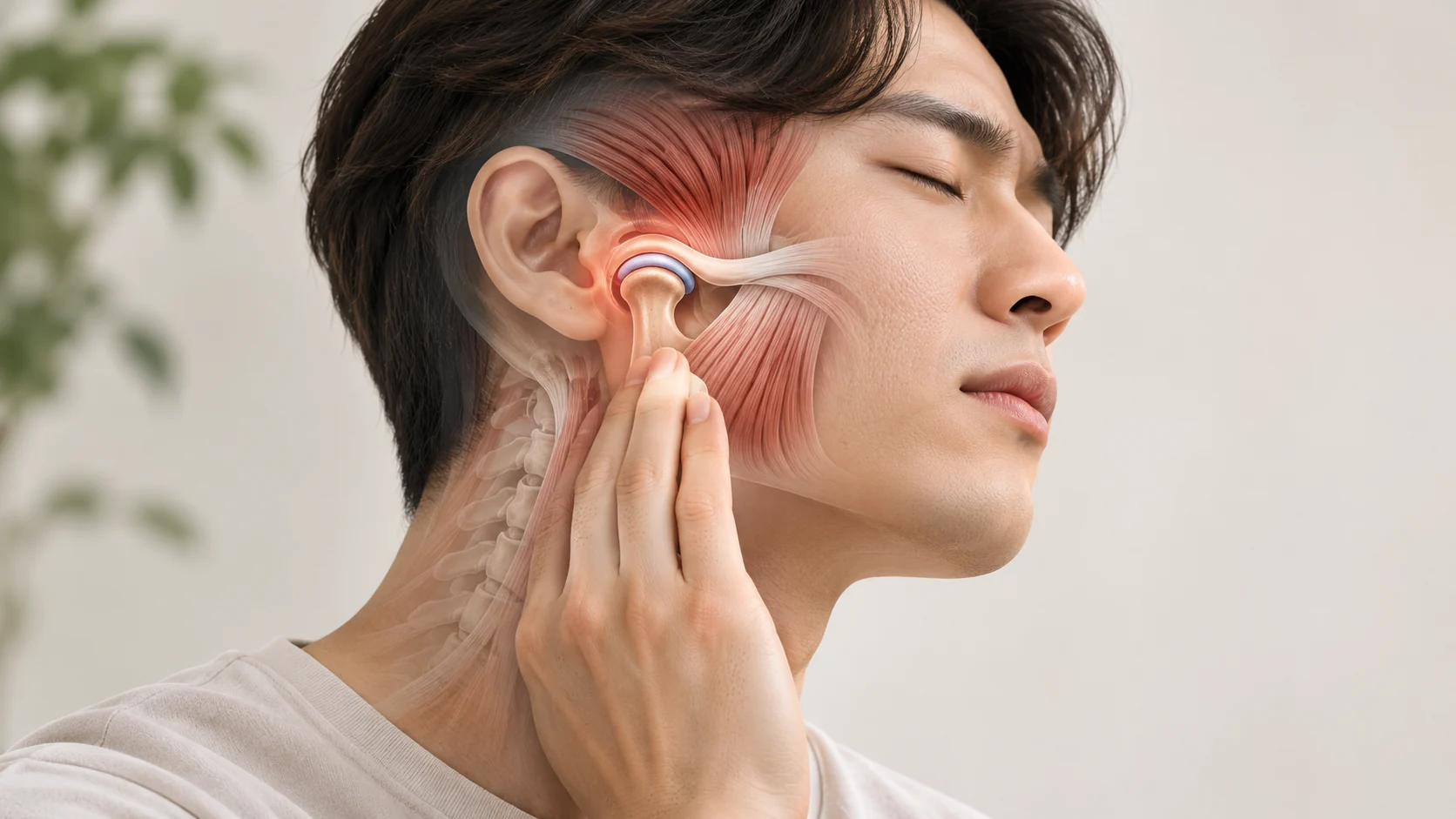
Jaw pain can affect everyday activities such as chewing, speaking, yawning, and even sleeping comfortably.
For some people, discomfort develops around the jaw joint in front of the ear. Others experience tightness in the chewing muscles, difficulty opening the mouth, headaches, or neck discomfort.
These symptoms may be associated with temporomandibular disorders (TMD), a group of conditions affecting the jaw joint and surrounding muscles.
Although pain is often felt around the jaw, several factors may contribute to symptoms, including muscle function, jaw movement, clenching habits, sleep, and associated neck discomfort.
In my clinical experience, evaluating the jaw together with the upper cervical spine, surrounding muscles, and functional movement patterns can provide additional information about an individual's symptoms.
Understanding these relationships may help guide an individualized treatment approach.
What Is TMJ and Temporomandibular Disorder?

The temporomandibular joint (TMJ) connects the lower jaw, or mandible, to the temporal bone of the skull.
There is one TMJ on each side of the face, located just in front of the ears.
These joints work together with the surrounding muscles to allow movements such as opening and closing the mouth, chewing, speaking, and moving the jaw from side to side.
The term TMJ refers to the joint itself, while temporomandibular disorder (TMD) describes conditions affecting the jaw joint, chewing muscles, or related structures.
TMD may involve muscle-related pain, joint-related problems, or headaches associated with jaw function.
Some conditions involve the articular disc, a structure within the joint that helps coordinate jaw movement.
However, not every episode of jaw discomfort indicates a structural problem or disc injury. Many cases improve with conservative management, although persistent symptoms may require further assessment.
Common Symptoms of TMJ Dysfunction
Temporomandibular disorders can produce different symptoms depending on the structures involved.
Common symptoms may include:
Pain or tenderness around the jaw joint
Discomfort while chewing
Tightness or soreness in the chewing muscles
Jaw stiffness or restricted opening
Painful clicking or popping
Difficulty opening the mouth comfortably
Headaches associated with jaw movement
Discomfort extending toward the face or neck
Episodes of jaw locking
One important distinction is that clicking or popping without pain or functional limitation is common and does not necessarily require treatment.
However, persistent pain, restricted jaw movement, or symptoms interfering with eating and daily activities should be appropriately assessed.
What Causes Jaw Pain?
There is not always one identifiable cause of temporomandibular disorders.
Several factors may contribute to the development or persistence of symptoms.
These may include:
Increased activity or tension in the chewing muscles
Jaw clenching or teeth grinding
Previous jaw or facial injuries
Joint-related changes
Stress-related muscle activity
Sleep disturbances
Individual pain sensitivity and related health conditions
For some people, symptoms become more noticeable during periods of increased stress or poor sleep.
Others may experience discomfort after prolonged jaw clenching, repetitive chewing, or an injury involving the jaw.
However, these factors do not affect everyone in the same way.
Research does not support the assumption that an imperfect bite or previous orthodontic treatment necessarily causes TMD.
A careful assessment should therefore consider the individual's symptoms, functional limitations, and relevant health history rather than attributing jaw pain to a single structural finding.
How Are the Jaw, Neck, and Posture Connected?

The jaw and neck are anatomically distinct regions, but their movements and symptoms can sometimes be related.
The muscles involved in jaw movement function alongside muscles that support the head and cervical spine.
Some people with TMD also experience neck discomfort, headaches, or muscle tenderness around the upper cervical region.
Research has identified associations between temporomandibular disorders and certain aspects of cervical function, including neck pain, movement limitations, and cervical joint position sense.
A 2023 systematic review and meta-analysis also reported an association between posture and TMD. However, the review included a limited number of studies, and further research is needed to clarify this relationship.
Therefore, differences in posture do not necessarily cause jaw problems, and not every postural asymmetry requires correction.
My Clinical Perspective on Jaw and Cervical Function
In my clinical experience, some patients with temporomandibular discomfort also present with differences in head position, upper cervical mobility, muscle tension, or asymmetrical jaw-opening patterns.
When evaluating these patients, I consider not only the temporomandibular joint itself but also the functional relationship between the jaw, upper cervical spine, and surrounding muscles and soft tissues.
I have observed that changes in cervical movement and muscle function may sometimes accompany differences in jaw movement or associated discomfort.
These observations have influenced my approach to musculoskeletal assessment.
Rather than focusing exclusively on the painful area, I also consider whether cervical movement restrictions, muscle-related factors, or other functional findings may be relevant to the patient's symptoms.
Although research has identified relationships between cervical function and TMD, a direct causal relationship between postural asymmetry and TMJ disc damage has not been established.
Similarly, changing posture or cervical alignment should not be assumed to repair a displaced or damaged TMJ disc.
For this reason, my clinical approach emphasizes identifying relevant functional limitations and associated symptoms rather than assuming that every jaw problem results from structural misalignment.
When clinically appropriate, an assessment may consider:
Jaw-opening direction and movement patterns
Upper cervical mobility
Head and neck positioning during functional activities
Muscle tenderness around the jaw and cervical spine
Differences in jaw movement between sides
Activities or positions that aggravate symptoms
Associated headaches or neck discomfort
These findings may help guide an individualized treatment plan, alongside jaw-specific care and referral for dental or medical evaluation when necessary.
How Is TMJ Pain Evaluated?
A careful assessment begins with understanding the patient's symptoms.
Important questions include when the pain started, where it is located, which movements aggravate it, and how it affects daily activities.
The history may also include previous dental problems, injuries, headaches, sleep concerns, or episodes of jaw locking.
A dentist or physician may evaluate jaw opening, joint movement, muscle tenderness, and other relevant findings.
Imaging is not necessary for every person with jaw pain.
However, dental imaging, MRI, or other investigations may be considered when the clinical findings suggest a need for further evaluation.
Because jaw pain can sometimes result from dental, ear-related, inflammatory, or other medical conditions, an appropriate diagnosis is important before beginning treatment.
What Does Research Say About Acupuncture for TMJ Pain?
Acupuncture has been investigated as a conservative treatment option for temporomandibular disorders.
A systematic review and network meta-analysis published in The BMJ in 2023 found moderate-certainty evidence suggesting that acupuncture may improve physical functioning in people with chronic TMD-related pain, compared with placebo or sham treatment.
The accompanying BMJ clinical practice guideline gave acupuncture a conditional recommendation for people experiencing chronic TMD pain lasting three months or longer.
This means that acupuncture may be considered as a treatment option for some patients, depending on their clinical presentation, preferences, and individual circumstances.
The guideline also provided strong recommendations for several conservative approaches, including patient education and usual care, supervised jaw exercises, and certain manual therapies.
These findings support considering acupuncture as one possible component of individualized care rather than a universally effective treatment.
What Do Korean Medicine Clinical Practice Guidelines Recommend?

Temporomandibular disorders have also been investigated within Korean medicine.
In South Korea, the Korean Medicine Clinical Practice Guidelines provide evidence-informed recommendations for managing various health conditions.
The Korean Medicine Clinical Practice Guideline for Temporomandibular Disorders was developed under the supervision of the Society of Korean Medicine Rehabilitation.
An updated guideline analysis published in Healthcare in 2023 reviewed clinical research and presented recommendations for several Korean medicine treatments.
The researchers evaluated available studies through systematic reviews, meta-analyses, and the GRADE framework.
Acupuncture
The updated Korean guideline assigned acupuncture a Grade A recommendation with a High level of evidence when compared with inactive controls, including sham treatments.
The studies reviewed showed improvements in pain-related outcomes among patients receiving acupuncture.
For comparisons between acupuncture and usual conservative treatment, the guideline provided a Grade B recommendation with a Moderate level of evidence.
These recommendations suggest that acupuncture may have a role in managing TMD symptoms, although the strength of the evidence depends on the treatment comparison and outcome being evaluated.
Chuna Manual Therapy
The Korean guideline also assigned Chuna manual therapy a Grade A recommendation with a High level of evidence when compared with usual conservative treatment.
The reviewed studies reported improvements in pain and certain measures of jaw function.
When Chuna was combined with conventional conservative care or other Korean medicine treatments, including acupuncture, the guideline provided Grade B recommendations with Moderate levels of evidence.
Exercise and Combined Treatment
Exercise therapy also received a Grade B recommendation with Moderate evidence.
The guideline considered the potential role of combining Korean medicine treatments with usual conservative care.
These recommendations reflect the evidence assessment and grading methods used by the Korean guideline development group.
The Korean guideline and the BMJ guideline evaluated different sets of evidence and treatment comparisons. Their recommendations should therefore be understood within their respective clinical and research contexts rather than interpreted as directly equivalent.
What Is Chuna Manual Therapy?
Chuna manual therapy is a traditional Korean manual treatment approach incorporating concepts of functional anatomy, movement, joints, muscles, and connective tissues.
Chuna integrates traditional Korean medicine principles with anatomical and biomechanical knowledge.
Depending on the technique and clinical circumstances, Chuna may involve:
Soft-tissue and myofascial techniques
Joint mobilization
Techniques directed toward movement restrictions
Other manual approaches selected according to clinical findings
Chuna is not a single standardized technique applied in the same way to every patient.
The approach may vary according to the anatomical region, symptoms, functional limitations, and clinical assessment.
In Korean medicine, Chuna is traditionally considered alongside other treatment approaches, including acupuncture and exercise-based management.
The 2023 Korean guideline update identified five studies comparing Chuna with usual conservative treatment, with three included in a meta-analysis of pain outcomes.
The pooled results favoured Chuna for pain reduction.
The guideline also reported improvements in certain measures of mouth opening and jaw function, although the evidence certainty for these outcomes was moderate.
Based on its assessment, the guideline development group assigned Chuna a Grade A recommendation with High evidence certainty for the relevant treatment comparison.
However, clinical results may vary according to the techniques used, individual patient characteristics, and study quality.
Further research remains valuable for understanding which patients may benefit most and how different treatment approaches compare.
Treatments described in Korean clinical research must also be distinguished from the techniques authorized under a practitioner's professional scope in other jurisdictions.
What Can You Do to Manage Jaw Discomfort?

Many people with mild TMD symptoms benefit from simple self-management strategies.
Depending on the symptoms, these may include:
Temporarily choosing softer foods
Avoiding prolonged jaw clenching
Reducing excessive gum chewing
Modifying activities that aggravate discomfort
Using gentle heat or cold for temporary comfort
Considering appropriate jaw exercises under professional guidance
Paying attention to sleep and stress-related habits
Aggressive stretching or forcing the jaw open should be avoided, particularly when pain or locking is present.
For persistent symptoms, an individualized assessment may help determine whether additional treatment or referral is necessary.
When Should Jaw Pain Be Medically Assessed?
Although many cases of jaw discomfort are not serious, certain symptoms require prompt evaluation.
Seek appropriate medical or dental assessment if you experience:
Significant difficulty opening or closing the mouth
Jaw locking that does not resolve
Increasing facial swelling or fever
Severe pain after an injury
New or unexplained changes in your bite
Persistent dental pain or suspected infection
Progressive symptoms that interfere with eating or drinking
Sudden severe symptoms, suspected infection, or an inability to eat or drink may require urgent medical or dental care.
Jaw pain accompanied by chest pressure, difficulty breathing, or other symptoms suggesting a cardiac emergency also requires immediate medical attention.
Jaw pain should not automatically be assumed to result from a temporomandibular disorder.
Other possible causes may need to be evaluated before treatment.
An Individualized Approach to TMJ and Jaw Pain
Two people with temporomandibular discomfort may have very different contributing factors.
One person may primarily experience muscle tenderness associated with clenching.
Another may experience restricted jaw opening, joint-related symptoms, or headaches occurring alongside neck discomfort.
A third person may have symptoms following an injury or require further dental evaluation.
For this reason, I believe treatment should consider the individual rather than focusing on the diagnosis alone.
My Background in Korean Medicine and Chuna Manual Therapy
I hold a current professional licence as a Doctor of Korean Medicine in South Korea, issued by the Ministry of Health and Welfare, Republic of Korea.
In New Brunswick, Canada, I practise as an acupuncturist (R.Ac.), drawing on my Korean medicine education and clinical experience.
Before practising in Canada, I served for approximately 10 years as an Education Committee Member in the Fascia and Soft Tissues Division of the Korean Society of Chuna Manual Medicine for Spine and Nerves (KSCMM).
During this period, I provided theoretical instruction and hands-on practical training in myofascial Chuna techniques to licensed Korean medicine doctors.
My responsibilities also included evaluating participants and grading professional training examinations.
During my teaching years in South Korea, I also held the society's Chuna Standard Curriculum Instructor Qualification (CIQ).
This professional experience contributed to my understanding of functional anatomy, myofascial assessment, cervical movement, and musculoskeletal function.
Today, this background continues to inform my clinical perspective when evaluating the relationship between pain, movement patterns, muscle function, and associated symptoms.
Rather than focusing exclusively on the location of pain, I consider relevant functional findings and the individual's overall clinical presentation.
My approach draws on Korean medicine education together with evidence-informed assessment and treatment principles.
Acupuncture may be considered when appropriate, alongside patient education, exercise-based management, and collaboration or referral to other healthcare professionals when needed.
The goal is to identify an appropriate approach based on the individual's symptoms, needs, and treatment goals.
TMJ & Jaw Pain Care in Moncton
Jaw pain can interfere with eating, speaking, sleeping, and everyday comfort.
Understanding whether symptoms involve the chewing muscles, temporomandibular joint, or another condition is an important first step.
An individualized assessment can help clarify the symptom pattern and determine which conservative treatment options or referrals may be appropriate.
For people seeking information about acupuncture and musculoskeletal care in Moncton, my approach combines Korean medicine education, extensive clinical experience, and an evidence-informed understanding of pain, movement, and function.
Learn more about my acupuncture services and professional background.
About the Author
Jung Dae Kwon, R.Ac.
Acupuncturist practising in Moncton, New Brunswick
Doctor of Korean Medicine (South Korea)
Licence issued by the Ministry of Health and Welfare, Republic of Korea
Professional Licence Clarification
My Doctor of Korean Medicine licence is valid in South Korea. In New Brunswick, Canada, I practise as an acupuncturist. I am not registered as a physician with the College of Physicians and Surgeons of New Brunswick (CPSNB) and am not licensed to practise medicine as a physician in New Brunswick.
Currently practising at OsteoFlow Health Clinic, Moncton, NB.
Book an acupuncture appointment in Moncton.
References
1. National Institute of Dental and Craniofacial Research (NIDCR).
Temporomandibular Disorders (TMD). National Institutes of Health.
2. Busse JW, et al. (2023).
Management of Chronic Pain Associated With Temporomandibular Disorders: A Clinical Practice Guideline.
BMJ. 2023;383.
3. Yao L, et al. (2023).
Management of Chronic Pain Secondary to Temporomandibular Disorders: A Systematic Review and Network Meta-analysis of Randomised Trials.
BMJ. 2023;383.
4. Kim H, et al. (2023).
Korean Medicine Clinical Practice Guideline Update for Temporomandibular Disorders: An Evidence-Based Approach.
Healthcare. 2023;11(16):2364.
5. Minervini G, et al. (2023).
Correlation Between Temporomandibular Disorders (TMD) and Posture Evaluated Through the Diagnostic Criteria for Temporomandibular Disorders (DC/TMD): A Systematic Review With Meta-analysis.
Journal of Clinical Medicine. 2023;12(7):2652.
This article is provided for general educational purposes and is not a substitute for medical or dental diagnosis or treatment. Research findings do not guarantee individual treatment outcomes. Professional qualifications and scopes of practice differ between South Korea and Canada, and treatments discussed in international research may not be available or authorized in every jurisdiction.
FAQ
Answers to your questions
Common questions about acupuncture care, appointments, treatment, insurance, and what to expect during your visit.
How do I book an appointment?
Do you accept walk-in patients?
Are you licensed and experienced?
Can I reschedule or cancel my appointment?
What types of health insurance do you accept?
Start With an Individualized Assessment
Book your appointment today and start feeling better.

Start With an Individualized Assessment
Book your appointment today and start feeling better.
Start With an Individualized Assessment
Book your appointment today and start feeling better.