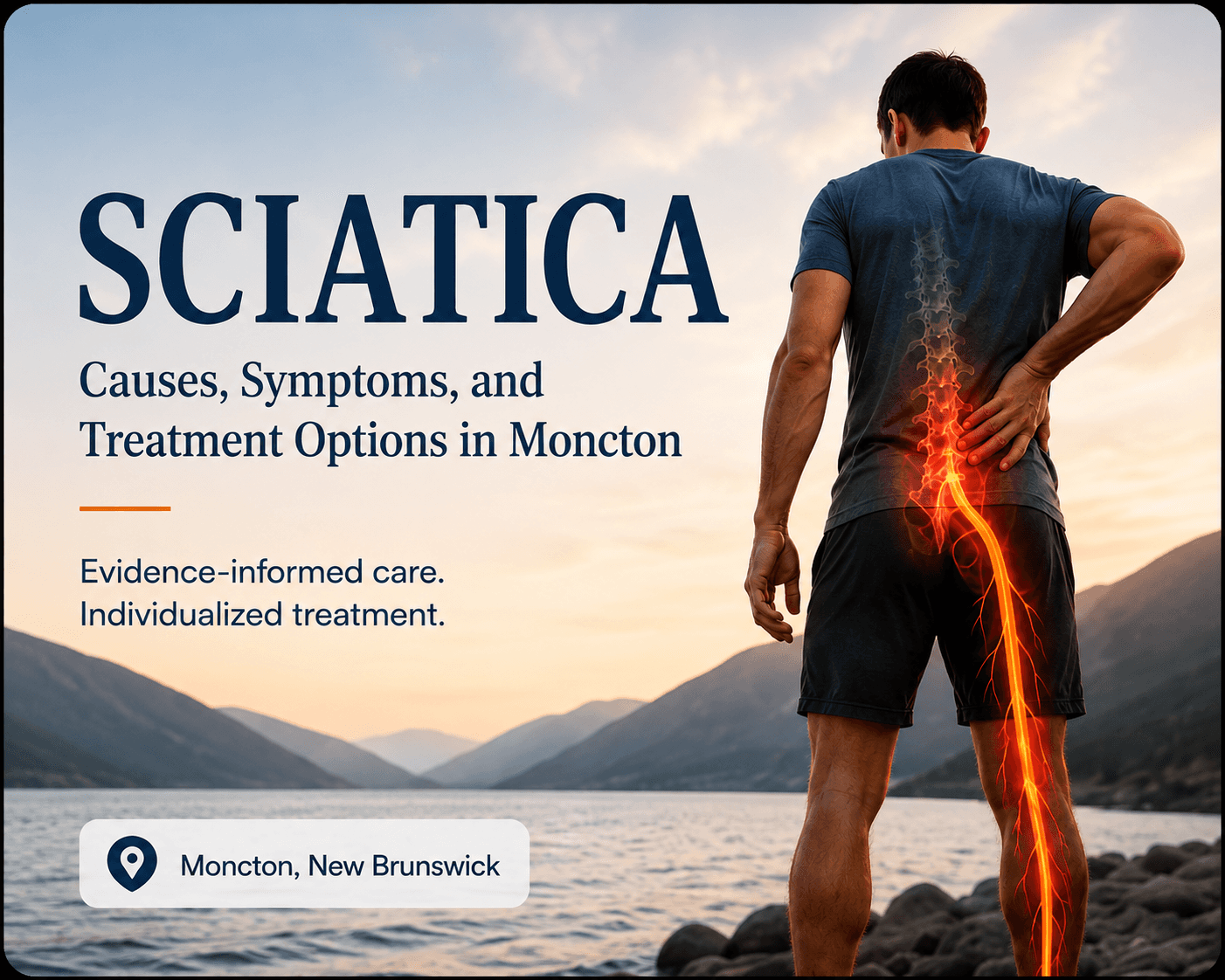
Sciatica can cause pain, numbness, tingling, or weakness that travels from the lower back or buttock into the leg.
For some people, the symptoms are relatively mild. For others, sharp, burning, or shooting pain can make sitting, walking, working, or sleeping difficult.
Understanding the pattern and possible cause of your symptoms is an important first step in determining an appropriate approach to care.
What Is Sciatica?
Sciatica refers to symptoms associated with irritation or compression of the nerve roots that contribute to the sciatic nerve.
The sciatic nerve is the largest nerve in the body and runs from the lower back through the buttock and down the leg.
Because of this pathway, irritation originating in the lower back can sometimes cause symptoms that are felt in the buttock, thigh, calf, or foot.
Common Symptoms of Sciatica
Sciatica commonly affects one side of the body.
Symptoms may include:
Lower back or buttock pain
Pain travelling down the back or side of the leg
Burning or shooting pain
Tingling or “pins and needles”
Numbness in the leg or foot
Weakness in the affected leg
Pain that becomes worse after prolonged sitting
The location and intensity of symptoms can vary depending on the structures involved.
What Causes Sciatica?
Sciatica is commonly associated with irritation or compression of a nerve root in the lower spine.
Possible causes include:
Herniated or bulging discs
Age-related changes in the spine
Bone spurs
Spinal narrowing
Inflammation or irritation around a nerve root
However, pain travelling into the leg does not always have the same cause. This is why an individual assessment is important, particularly when symptoms persist or become progressively worse.

Why Does Sciatica Pain Travel Down the Leg?
The nerve roots that contribute to the sciatic nerve originate in the lower spine. These nerve roots join together in the pelvis to form the sciatic nerve, which then travels through the buttock and down the leg.
When one of these nerve roots becomes irritated or compressed, symptoms may be experienced along the pathway of the nerve rather than only at the source of the problem.
This is why a problem originating in the lower back may sometimes be experienced as pain, tingling, numbness, or weakness farther down the leg.

Beyond the Location of Pain
Pain travelling into the leg does not always indicate the same underlying condition. A clinical assessment may consider the pattern of symptoms, changes in sensation or strength, medical history, and limitations in daily movement. Posture, joint mobility, and movement patterns can provide additional information, but they should not be used alone to diagnose nerve compression.
Treatment and Management Options
Treatment for sciatica depends on the underlying cause, severity of symptoms, and each person’s individual condition.
Conservative management may include activity modification, appropriate exercise or rehabilitation, physical therapy, medication when appropriate, and other approaches aimed at managing symptoms and maintaining function.
In some cases, acupuncture may also be considered as part of a conservative approach to care.
Can Acupuncture Help With Sciatica?

Acupuncture is one option that may be considered for people experiencing sciatica-related pain and discomfort.
Rather than treating every person with sciatica in the same way, acupuncture care is individualized based on the location and pattern of symptoms, physical findings, health history, and other relevant clinical information.
Treatment may involve acupuncture points in the lower back, hip, or leg, as well as other points selected according to the individual assessment.
What Does the Research Say?
A 2024 randomized clinical trial published in JAMA Internal Medicine involving 216 patients with chronic sciatica caused by a herniated lumbar disc found that acupuncture provided greater improvements in leg pain and physical function than sham acupuncture after four weeks of treatment.
Korean Medicine Clinical Practice Guidelines for Lumbar Herniated Intervertebral Disc in Adults also recommend acupuncture for improving symptoms associated with lumbar disc herniation. The guidelines include recommendations for acupuncture alone and in combination with conventional treatment.
However, these findings and recommendations primarily concern lumbar disc herniation and should not be generalized to every cause of sciatica. Clinical guidelines also differ internationally, and treatment decisions should consider the patient's individual condition and the available evidence.
My Approach to Sciatica Care
In my practice, an initial course of care commonly involves approximately 5–6 treatments, often scheduled once or twice per week. Progress is reassessed during this period, and the treatment plan may be adjusted depending on the individual response.
The number and frequency of treatments can vary, and improvement cannot be guaranteed.
Should I Bring My MRI or X-ray?
If you have previous MRI or X-ray images, imaging reports, or other relevant medical documents, you are welcome to bring them to your appointment.
These records may provide useful background information and can help me better understand your medical history and any findings that may be relevant to your symptoms.
However, imaging findings do not always explain the cause of pain on their own. They are considered together with your symptoms, health history, and clinical assessment.
Acupuncturists do not replace medical imaging or a physician’s diagnosis. If further medical investigation or imaging appears appropriate, you may be advised to consult your physician or another appropriate healthcare provider.

When Should You Seek Medical Attention?
Most cases of sciatica do not require emergency care. However, some symptoms should be assessed promptly by a medical professional.
Seek medical attention if you experience:
Significant or worsening weakness in the leg
Numbness that is severe or rapidly worsening
Severe symptoms following a significant injury
Fever or feeling significantly unwell together with new or severe back pain
Seek emergency medical attention immediately if you develop new bladder or bowel dysfunction, numbness around the groin or saddle area, or sudden, severe, or rapidly worsening leg weakness, particularly if both legs are affected.
If you are unsure whether your symptoms require medical assessment, it is appropriate to speak with your physician or another qualified healthcare provider.
What to Expect at Your First Appointment
Your first appointment begins with a discussion of your symptoms, health history, and how the condition is affecting your daily activities.
A clinical assessment is then performed to better understand the location and pattern of your symptoms and to determine whether acupuncture may be appropriate for you.
If you have previous MRI or X-ray images, radiology reports, or other relevant medical records, you are welcome to bring them with you. However, imaging is not required before your first appointment.
If acupuncture is appropriate, an individualized treatment plan will be discussed based on your assessment and response to care.
Acupuncture Care for Sciatica in Moncton
If you are experiencing sciatica-related pain, numbness, tingling, or discomfort, an individualized assessment can help determine whether acupuncture may be an appropriate part of your care.
Acupuncture appointments are available in Moncton, New Brunswick.
Book an acupuncture appointment in Moncton.
Written by Jung Dae Kwon, R.Ac.
Registered Acupuncturist in New Brunswick
Doctor of Korean Medicine — Licensed in the Republic of Korea
References
Tu JF, Shi GX, Yan SY, et al. Acupuncture vs Sham Acupuncture for Chronic Sciatica From Herniated Disk: A Randomized Clinical Trial. JAMA Internal Medicine. 2024;184(12):1417–1424.
Goo B, Jo MG, Kim EJ, et al. Korean Medicine Clinical Practice Guidelines for Lumbar Herniated Intervertebral Disc in Adults: Based on Grading of Recommendations Assessment, Development and Evaluation (GRADE). Healthcare. 2022;10(2):246.
National Institute for Health and Care Excellence (NICE). Low Back Pain and Sciatica in Over 16s: Assessment and Management. NICE Guideline NG59. Published 2016; updated 2026.
This article is provided for general educational purposes and is not a substitute for medical diagnosis or treatment. Individual results and treatment needs may vary.
FAQ
Answers to your questions
Common questions about acupuncture care, appointments, treatment, insurance, and what to expect during your visit.
How do I book an appointment?
Do you accept walk-in patients?
Are you licensed and experienced?
Can I reschedule or cancel my appointment?
What types of health insurance do you accept?
Start With an Individualized Assessment
Book your appointment today and start feeling better.

Start With an Individualized Assessment
Book your appointment today and start feeling better.
Start With an Individualized Assessment
Book your appointment today and start feeling better.